Skip to content
FV Francesco Vigni
Francesco Vigni

Selected work

Evidence, not slideware.

Each of these is a real system that had to work under real constraints: context, what made it hard, what I did, and what came of it.

Research, on public data

All research →

Endoscopy · acquisition shortcuts

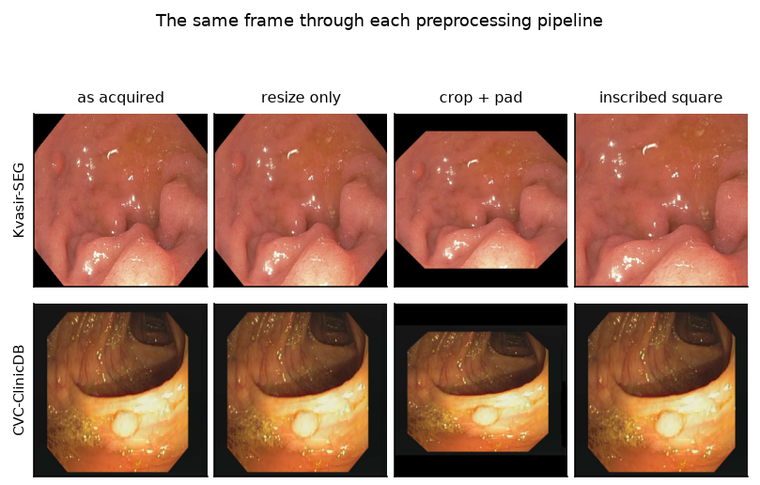
You can tell which hospital a colonoscopy frame came from 96% of the time, without looking at the anatomy, and the standard fix barely helps.

Nine numbers describing the frame the equipment drew (letterboxing, the field-of-view mask, the burned-in date) identify the source dataset out of five, at chance 0.20.

  • 0.961 as acquired
  • 0.859 after the standard crop-and-pad
  • 0.891 from a frozen self-supervised encoder
The same endoscopic frame shown through four preprocessing pipelines, for two source datasets

Four findings, and the one that failed →

Repository

Fetal ultrasound · orientation

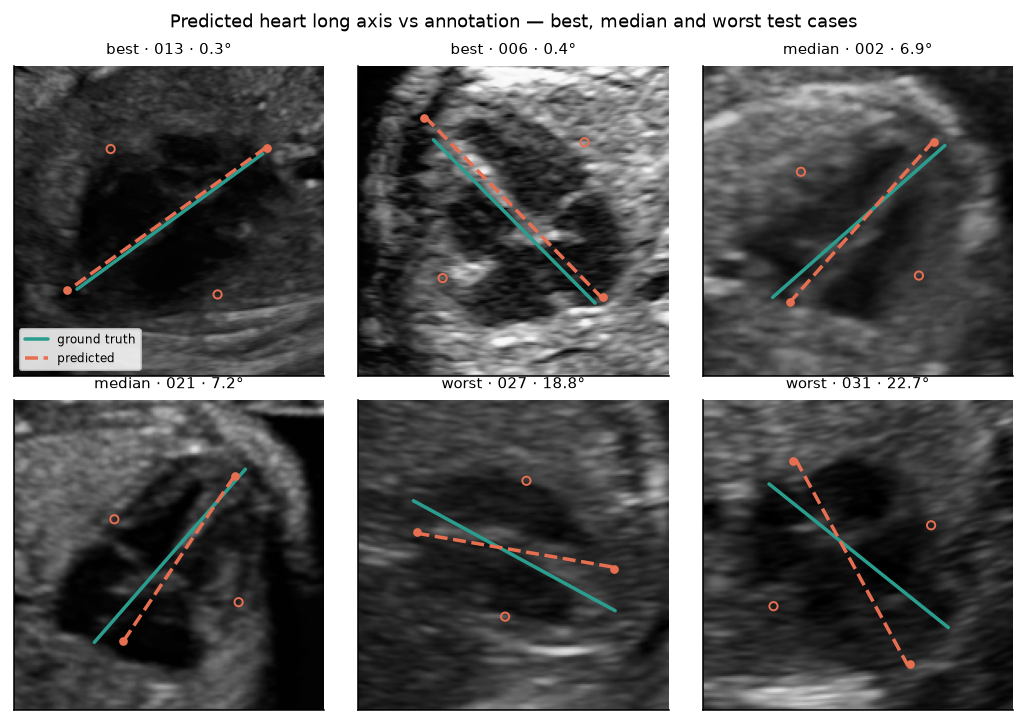
Estimating fetal cardiac orientation does not need a trained model: closed-form geometry beats the network by two orders of magnitude.

The useful part is knowing when that shortcut breaks. It does not break where the usual quality score says it should: a mask scoring Dice 0.87 can give a 46° error, one at 0.77 gives 0.22°.

  • 0.28° second-order moments, no training
  • 7.04° trained landmark model, box only
  • ±18° 95% limits of agreement
Six fetal four-chamber ultrasound frames with the annotated and predicted heart axes overlaid, labelled best, median and worst

Why landmarks, and where they break →

Repository

Also published standalone at portfolio.francescovigni.com

Deployment stories

Foundation Model for Gastroenterology Imaging

AI / ML Research

5M+ frames gastrointestinal video, self-supervised pretraining

  • Self-Supervised Learning
  • PyTorch
  • Medical Imaging
  • Vision Transformers
Context
An IRCCS hospital needed a foundation model for endoscopic polyp detection, trained on more than 5 million gastrointestinal video frames.
Constraints
Strict GDPR compliance and NDA boundaries, cloud-GPU cost ceilings, and a need for reproducible experiments across model architectures.
What I did
Designed the SSL pretraining strategy (masked image modelling with DINOv3-style self-distillation), built the cloud data ingestion pipeline, and set up experiment tracking and fine-tuning protocols for classification, segmentation, and detection.
Outcome
A reproducible foundation-model pipeline over 5M+ frames, with data governance designed with future EHDS requirements in mind and a path toward clinical validation and edge inference.

Edge AI Occupancy Monitoring System

Robotics & Edge

Real-time on Jetson on-device tracking and distance estimation, MQTT zone events

  • NVIDIA Jetson
  • Computer Vision
  • PyTorch
  • YOLO
Context
A ceiling-mounted system to monitor occupancy and inter-person distance, driving lighting cues when distance violations occur.
Constraints
Real-time inference on an NVIDIA Jetson, accurate distance estimation from a single top-view camera, minimal occlusions at 3-6 m mounting height.
What I did
Built a compact detection-and-tracking pipeline, calibrated the camera and applied homography to project detections onto the floor plane, and published zone events over MQTT.
Outcome
A working edge deployment performing real-time people tracking, distance estimation, and MQTT-driven lighting on constrained hardware.

Autonomous Navigation for an Industrial Cleaning Robot

Robotics & Edge

Production deployment ROS2 / Nav2 coverage navigation on a commercial ride-on scrubber

  • ROS2
  • Nav2
  • SLAM
  • Lidar
Context
A commercial ride-on floor scrubber needed an autonomous indoor navigation stack for large facilities such as warehouses, retail spaces, and airports.
Constraints
Robustness to floor sheen, reflective obstacles and mixed lighting; human-safe behaviour; repeatable coverage routes; simple operator workflows.
What I did
Developed the ROS2/Nav2 navigation stack (SLAM, localization, and coverage path-planning) and validated it in simulation (CoppeliaSIM) and on the platform.
Outcome
Reliable autonomous navigation with repeatable coverage paths and smooth, human-safe motion in large indoor environments.

+9% grasp reliability industrial bin-picking, shipped in rc_visard and rc_cube

  • Computer Vision
  • Stereo Vision
  • C++
  • ROS2
Context
Roboception's stereo-based perception products power industrial pick-and-place. Grasping needed to be more reliable in real factory conditions.
Constraints
Challenging factory lighting and clutter, tight latency budgets, and deterministic production-ready behaviour for integration teams.
What I did
Designed and implemented core C++/Python software for rc_visard and rc_cube, improved grasp generation and validation in the rc_reason component, and tightened the sensing-to-planning data flow.
Outcome
Faster pick-and-place cycles and more stable grasp proposals under difficult lighting and clutter, improving grasp reliability by 9%.

Self-Hosted Kubernetes Platform

DevOps & Infrastructure

12+ services on one k3s node health-gated, reversible Helm delivery with automatic rollback

  • Kubernetes (k3s)
  • Helm
  • Caddy
  • CI/CD
  • PostgreSQL
Context
A personal Linux VPS hosting over a dozen services (analytics, workflow automation, CRM, dashboards, custom web apps), migrated onto a single-node Kubernetes (k3s) cluster, each packaged as a Helm chart.
Constraints
Zero-downtime, reversible cutovers; stateful databases with live data migration; automatic rollback; production incident recovery, all on one node.
What I did
Authored Helm charts (Deployments, Services, ConfigMaps, Secrets, PersistentVolumes, init-containers, readiness/liveness/startup probes), built health-gated delivery with `helm upgrade --atomic` and digest-pinned images, and ran live credential rotation and incident debugging (OOM self-healing).
Outcome
A reversible, self-healing platform with Caddy as the retained TLS edge, Cloudflare zero-trust access, and backup-first attended upgrades for stateful data.

Non-Verbal Human-Robot Interaction with TIAGo

AI / ML Research

Multi-machine ROS2 user study published in IEEE: bi-manual TIAGo with synchronised gaze

  • HRI
  • MoveIt
  • ROS2
  • Motion Planning
Context
A TU Wien research study on whether a robot's non-verbal behaviour makes its intentions legible to people during a collaborative task.
Constraints
Safe, collision-free motion around people; precise temporal coordination of head and arm; a controlled within-subject experimental design.
What I did
Built the interaction engine on the bi-manual TIAGo robot with MoveIt motion planning, synchronized gaze control, and ROS state machines, then ran the user study.
Outcome
Coordinated gaze-and-arm behaviour measurably improved perceived intention clarity, engagement, and interaction fluency (published, IEEE).
Career & milestones Publications, talks, and the personal story.

Publications

Peer-reviewed work.

  1. 2025 Proceedings of the ALTRUIST, BAILAR, SCRITA and WARN 2024 workshops Published online
  2. 2024 Too Close to You? Emotion-Adapted Proxemics Behaviours IEEE RO-MAN, Pasadena
  3. 2024 Emotion-based social distances for robot path planning IEEE RO-MAN, Pasadena
  4. 2024 A Rosbag Tool to Improve Dataset Reliability ACM/IEEE HRI, Boulder
  5. 2023 Sweet Robot O'Mine: How a Cheerful Robot Boosts Users' Performance IEEE RO-MAN, Busan
  6. 2022 Non-verbal strategies for initiating human-robot interaction ICSR, Florence
  7. 2022 Emotional transparency of a non-humanoid social robot ICSR, Florence
  8. 2022 Familiar acoustic cues for legible service robots IEEE RO-MAN, Naples
  9. 2019 The Role of Closed-Loop Hand Control in Handshaking Interactions IEEE Robotics and Automation Letters (RA-L)

Full list on Google Scholar

Recognition

  • 1st prize, 2nd Startup Creation Lab, Università di Bologna (2025)
  • Marie Skłodowska-Curie Fellow, EU H2020 project PERSEO (2021)
  • Best Paper Award finalist in HRI, IEEE ICRA (2019)

Speaking

Talks and interviews.

  • May 2026

    Intervista su IA e sviluppi tecnologici

    Story-Time, Canale Italia, Bologna

    Una breve intervista su Intelligenza Artificiale e sviluppi tecnologici. Il modo in cui il mondo reale e il mondo virtuale si uniscono.

  • Aug 2024

    Too Close to You? A Study on Emotion-Adapted Proxemics Behaviours

    33rd IEEE RO-MAN 2024, Pasadena, California

    A study on emotion-adapted proxemics behaviours.

  • Mar 2024

    Datemi un bit e solleverò il mondo

    Istituto Salesiano Sacro Cuore, Naples

    A talk on the implications of Robotics and AI in the future of our societies, presented to ~200 high-school students at the Teatro Auditorium Salesiano Salvo D'Acquisto.

  • Mar 2024

    A Rosbag Tool to Improve Dataset Reliability

    ACM/IEEE HRI 2024, Boulder, Colorado

    Late Breaking Report presentation on a tool for improving the reliability of ROS bag datasets in human-robot interaction research.

  • Aug 2023

    Sweet Robot O'Mine: How a Cheerful Robot Boosts Users' Performance

    IEEE RO-MAN 2023, Busan, South Korea

    Presentation of the paper exploring how a robot's cheerful communication style impacts user task performance in a game scenario.

  • May 2019

    The Role of Closed-Loop Hand Control in Handshaking Interactions

    IEEE ICRA 2019, Montreal, Canada

    Presentation of the paper on the role of closed-loop hand control in handshaking interactions.

The video loads from YouTube only when you press play.

FV Francesco Vigni

My story

From a robotics thesis at Disney to AI in the clinic.

I studied engineering in Siena, and did my Master's thesis at Disney Research Zurich, on closed-loop control for a robot that shakes your hand, which ended up as a paper in IEEE RA-L. That set the tone for everything since: I like building things that have to work with real people, in the real world.

I spent years in Germany making that happen: autonomous mobile robots deployed across factories, and core 3D-perception and grasping software at Roboception for industrial pick-and-place. Then I went back to research for a Marie Skłodowska-Curie PhD in Naples, with secondments at TU Wien and studying how robots make their intentions legible to people.

Today I lead the technical development of a self-supervised foundation model for medical imaging with a European clinical institute. It is the work I most want to keep doing. Alongside it I run a small self-hosted Kubernetes platform for my own services, because I like owning the whole stack, from the model down to the metal.

I'm Italian, based in Forlì, and I speak Italian, Spanish, and English (plus some German).